What is a Thread?
Foundations for Empirical Exploration in Coordination as Power

Introduction
In traditional political and social theory, power is often treated as a property held by individuals, groups, or institutions; a capacity to coerce, influence, or govern. The Coordination as Power (CfP) framework shifts this perspective by understanding power as an emergent property of coordination itself: power arises through the dynamic processes by which individuals and entities align their actions, intentions, and internal states. Within this paradigm, the thread is introduced as the fundamental unit of coordination; an irreducible mechanism through which alignment is initiated, maintained, or disrupted.
This essay explicates what a thread is, delineating its six core dimensions, its boundary conditions, and the political interface that arises where coordination meets contestation and transformation. By clarifying the concept of the thread, this work lays a conceptual and methodological foundation for the empirical investigation of power as coordination.
Defining the Thread: The Fundamental Unit of Coordination
A thread is the minimal, irreducible unit of coordination within a system or collective. It is the processual mechanism by which entities become aligned through rules, signals, rituals, algorithms, gestures, or other forms of communicative and procedural action. Unlike traditional notions of power as possession or domination, a thread functions as a channel of alignment that binds participants in coordinated activity.
Threads are irreducible in that they cannot be broken down into smaller components without losing their essential function: the enactment and maintenance of alignment. They operate across human and non-human systems alike, making the thread a versatile conceptual tool for analyzing coordination dynamics in political institutions, social movements, technological platforms, ecological networks, and beyond.
The Six Dimensions of a Thread
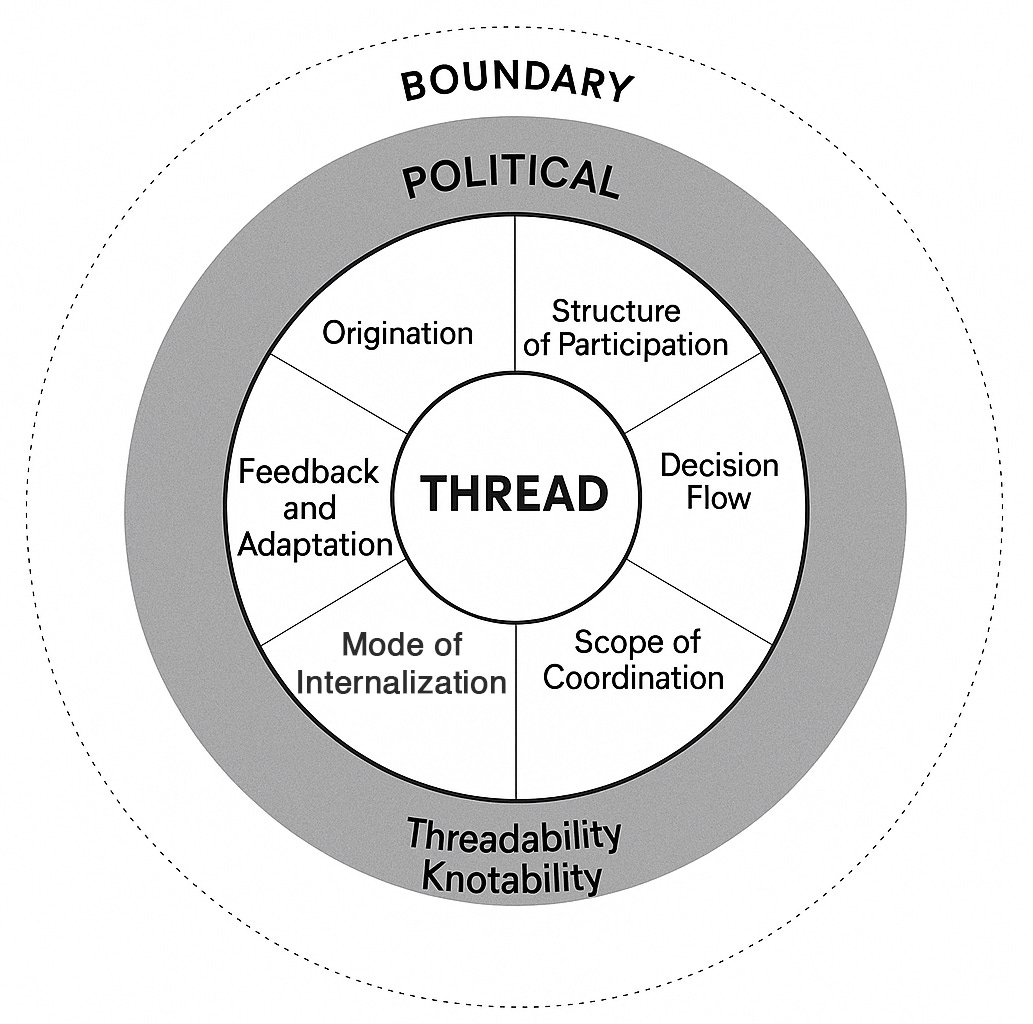
The complexity of coordination requires unpacking the thread into six interrelated dimensions. These dimensions jointly shape the texture and functioning of any given thread:
Origination
This dimension concerns who or what initiates the thread, including the source of authority or genesis of coordinated activity. It shapes legitimacy and the capacity to activate or block coordination.Structure of Participation
Defines who is included or excluded, roles and responsibilities, and patterns of engagement. This dimension determines the membership and agency within the thread.Decision Flow
Captures how decisions are made and how agency is distributed along the thread. It includes the sovereignty of actors and the pathways through which influence travels.Scope of Coordination
Establishes the thematic, spatial, temporal, and organizational boundaries of the thread; what issues, locations, or periods the thread encompasses.Mode of Internalization
Describes how participants internalize shared meanings, norms, or practices that sustain the thread. This includes cognitive, cultural, emotional, or embodied internalization mechanisms.Feedback and Adaptation
Encompasses the mechanisms by which the thread responds to internal signals or external pressures, maintaining coherence or evolving over time.
These dimensions interact continuously to sustain the thread’s coherence or precipitate its transformation or rupture.
Thread Boundaries and Their Texture
A thread boundary is the emergent threshold where coordinated coherence within the thread ceases to propagate effectively. Rather than a fixed line, the boundary is a dynamic patterning threshold that manifests in relational, semantic, and procedural spaces.
The texture of a thread boundary arises from how each of the six coordination dimensions is configured at the edge. For instance, a boundary may be rigid in participation but porous in feedback, or contested in decision flow but clear in origination. This multidimensional texture explains the felt qualities of the boundary, whether it is sticky, frayed, permeable, or rigid, and offers a nuanced lens to observe the thread’s stability and transformation potential.
The Political Interface: Negotiating the Edge
Where thread boundaries become salient (activated, contested, or ambiguous), the political interface emerges. This interface is the reflexive layer of negotiation, interpretation, and power dynamics that governs access, continuity, and transformation at the edge of coordination.
Politics, in this framing, is not confined to formal institutions or ideological struggles. Instead, it is the ongoing process through which the boundary conditions of coordination systems are established, challenged, and remade. The political interface mediates tensions between threadability (the capacity to allow new connections and transformations) and knotability (the capacity to stabilize, resist, or exclude), balancing openness and order.
Implications for Empirical Research
Formalizing the thread with its six dimensions, boundaries, and political interface enables a shift to empirical inquiry:
Researchers can identify observable markers of thread activation, coherence, and rupture across diverse domains.
The texture of boundaries offers a multi-scalar analytic tool to diagnose where and how coordination strains or thrives.
The political interface highlights moments and sites where power is enacted through negotiation over inclusion, meaning, and adaptability.
Together, these concepts support the development of methodologies to track coordination patterns as embodied expressions of power, fostering new insights into how collective action emerges, endures, or fails.
Conclusion
A thread is the foundational mechanism through which coordination and thus power emerge. By articulating its six dimensions, its dynamic boundaries, and the political interface that animates its edges, the CfP framework provides a robust conceptual apparatus for understanding power as a relational and processual phenomenon. This essay serves as the conceptual starting point for empirical exploration, inviting researchers to map, measure, and engage with power embedded in the fabric of coordination.
Are you seeing how threads and memeforms are related? What I’m seeing in threads serving as vehicles for meme transmission and as scaffolds for memeform internalization. Cool, no?